




NEWS
- News Type
- Industry dynamics
- Company News
- Technical knowledge
Daqing Oilfield develops wide-area tracer logging technology
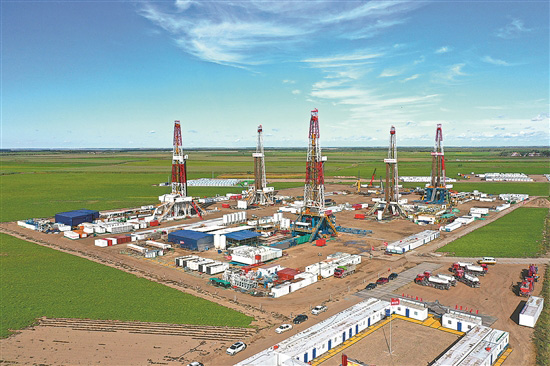
On September 7th, the reporter learned from the Testing Technology Service Branch of Daqing Oilfield that its successfully developed wide area tracer logging technology has achieved a breakthrough in both accuracy and efficiency of reservoir water injection monitoring. This technology is the first of its kind in China and can effectively identify water absorbing layers with an injection depth of only 0.2 meters and a water injection volume of 0.3 cubic meters per day. The average efficiency of the test has been improved by 45%, and the average amount of isotope carrier used has been reduced by 83%, providing technical support for the fine development of oil fields.
This technology innovatively develops the processes of "anti flocculation coating" and "surface active coating", which are suitable for testing the water absorption profile of various injection media. Its unique "ball source co production" technology can flexibly adjust the isotope specific activity to 1 to 30 times, meeting the monitoring needs of water injection intensity from 10 cubic meters/day to 200 cubic meters/day. Compared with traditional techniques, this technology significantly improves the identification ability of thin and poor oil layers, especially suitable for high water cut oil fields.
It is reported that this technology has completed a total of 215 on-site tests, with a success rate of 100%. It not only ignores interlayer contradictions and successfully captures the highest water absorption signal of 53.8 cubic meters per day and the lowest of 1.3 cubic meters per day, but also successfully divides the 21 meter thick layer and the continuous layer with interlayer less than 1 meter into 11 water absorption units in the ternary injection well. It accurately identifies 9 thin differential layers with suction volume less than 3 cubic meters per day, laying a detailed data foundation for subsequent adjustment and optimization plans.